
The most common question we get at Mizu isn't about taxes or banking. It's the first one: "Can I even form a US company without living there?" The answer is yes, fully remote, no visa required. But the order matters, and most founders who try to DIY this end up redoing steps because nobody walked them through the sequence.
This guide is the full path. Every step a non-US founder takes to form a US LLC, get an EIN, open a bank account, and activate Stripe, in the exact order that actually works in 2026. If you're starting from zero, start here.
TL;DR
A non-US founder can form a US LLC entirely remotely in about two weeks. Most solo founders not raising venture capital should form in Wyoming: $60 annual fee, no state income tax, owner privacy, no franchise tax. The setup is seven steps in a specific order: registered agent, name check, US business address and phone, file Articles of Organization, sign an operating agreement, get an EIN, open US business banking. Year-one cost lands around $700 to $1,200 all-in. Annual maintenance after that is roughly $300 to $800 per year. The single biggest pitfall most founders don't know about is Form 5472, an annual IRS filing with a $25,000 penalty.
Why Most Non-US Founders Choose a US LLC
There are three real paths to accept US payments as a non-US founder. A US LLC, a Delaware C-corporation, or a merchant-of-record platform like Paddle or LemonSqueezy. Each works for different situations.
A Delaware C-corporation makes sense if you're raising venture capital. Every US investor, their lawyer, and the standard SAFE template assumes a Delaware C-corp. The tradeoff is $300 per year in franchise tax, more complex returns, and potential double taxation on retained earnings.
A merchant-of-record platform removes the need for a US entity at all. The platform handles tax, VAT, and global compliance, in exchange for 5 to 7 percent of every transaction. Your customers see the platform's name on their card statements, not yours.
A US LLC is the middle path. Lower cost than a C-corp, full ownership of the Stripe relationship, your own banking. Most non-US solo founders without US employees or US-based physical operations qualify for no US federal income tax under standard ECI rules (more on that below).
Why Wyoming Beats Delaware for Most Non-VC Founders
Most non-US founders compare Wyoming and Delaware. The actual numbers:
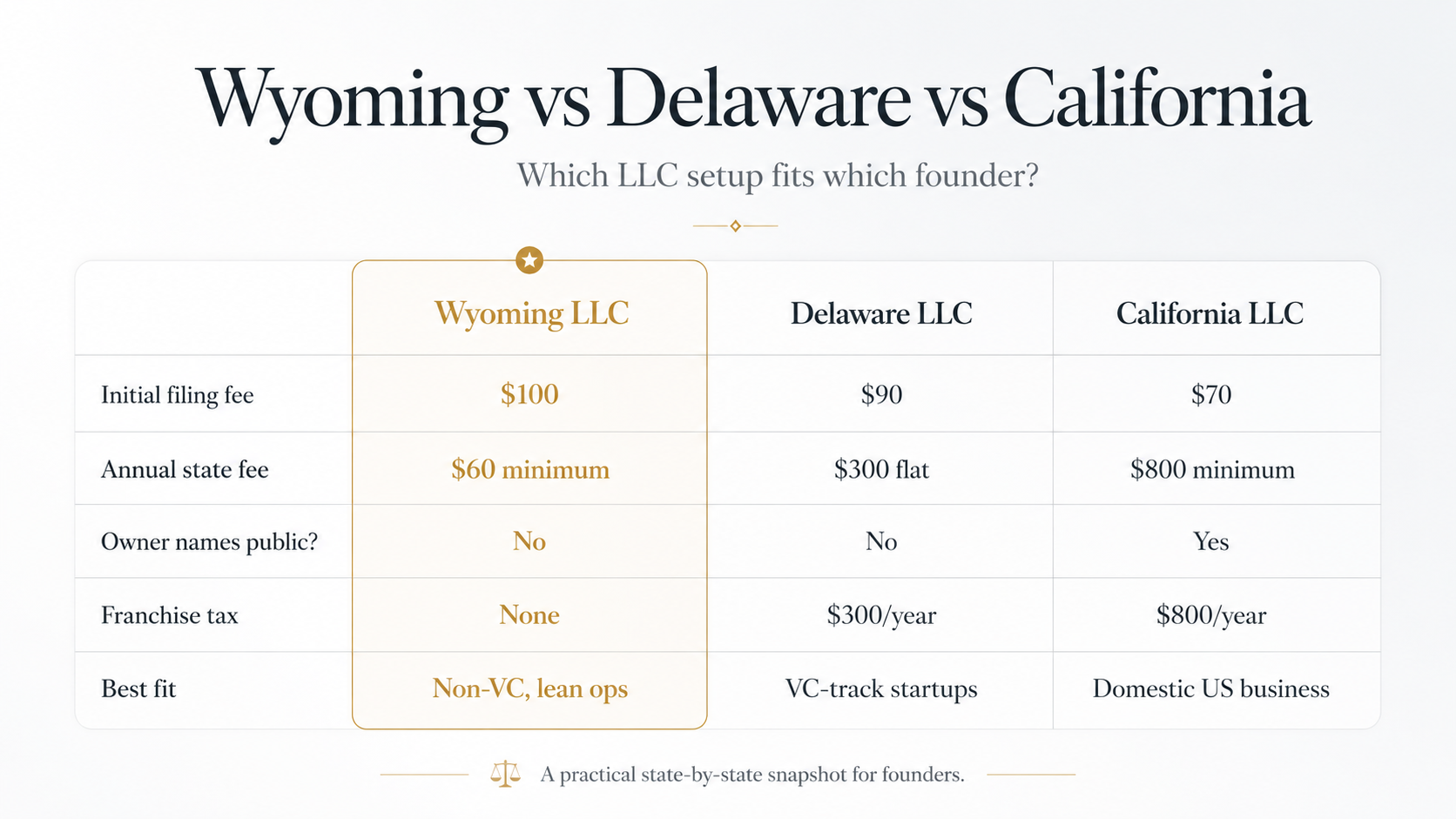
The cost gap is real. Wyoming charges a $60 minimum annual report fee, calculated as $0.0002 times Wyoming-located assets, whichever is greater. For a foreign-owned LLC with no Wyoming property, that's $60. Delaware charges $300 every year regardless of revenue or activity. Over 10 years that's a $2,400 difference per LLC.
Privacy is real too. Wyoming doesn't publish member or manager names in its online business registry. Delaware doesn't either. California does.
California is rarely right for a non-US founder and worth flagging because some formation services upsell it. The $800 minimum franchise tax applies even if you do nothing in California, and member names are public.
For a non-US founder not raising venture capital, Wyoming is the practical default. The rest of this guide assumes that. We covered the full state-choice question in our US LLC Cost for Non-Residents in 2026: Full Breakdown.
US Tax for Foreign-Owned LLCs: The Honest Version
This is where most guides oversimplify. The accurate framing:
A single-member LLC owned by a non-US person is a "disregarded entity" for federal tax purposes. The LLC itself doesn't pay corporate income tax. Profits flow through to the owner.
Whether you, the foreign owner, owe US federal income tax depends on whether your business generates Effectively Connected Income (ECI) from a US Trade or Business (USTB).
You generally do not owe US federal income tax if all of these are true:
- You live and operate outside the US
- You have no US employees or dependent contractors working inside the US
- You don't lease US office space, warehouses, or fulfillment infrastructure
- Your work product is delivered remotely (software, consulting, digital services)
You generally do owe US federal income tax if any of these are true:
- You have US-based employees or dependent contractors
- You hold inventory in US warehouses (including Amazon FBA in many cases)
- You spend substantial time physically in the US conducting business
ECI is fact-specific, especially for e-commerce founders using Amazon FBA or US fulfillment networks. Inventory stored in the US can create state-level nexus in ways that catch founders off guard. If your model involves US physical operations, talk to a CPA who handles cross-border cases before assuming you owe nothing.
Even if you owe zero income tax, you still owe an annual information return to the IRS. That's where most founders get caught. See the compliance section below.
The Seven-Step Setup Order (This Sequence Matters)
The biggest cause of Stripe rejections and Mercury holds isn't bad documents. It's founders completing steps out of order and then failing automated verification. Follow this sequence.
Step 1: Hire a Registered Agent in Wyoming
What it is: A registered agent is a physical address inside Wyoming that accepts official state mail and legal notices during business hours. You can't be your own registered agent unless you live in Wyoming.
Cost: $50 to $200 per year for a commercial agent service.
What to look for: Electronic mail forwarding so you can manage everything remotely. Avoid bundled "free for the first year" registered agent offers from cheap formation services. They usually auto-renew at higher prices in year two.
Step 2: Confirm Your Business Name Is Available
Check the Wyoming Secretary of State business name search before you file anything. Your name must be unique and end with "LLC" or "Limited Liability Company." Restricted words like "Bank," "Insurance," or "Trust" require specific regulatory approval.
This is a five-minute step that people skip and then have to refile.
Step 3: Set Up a US Business Address and Phone
This step trips up almost every DIY founder.
Why your registered agent address isn't enough: Banks, Stripe, and most US service providers will reject applications that use a registered agent address as your operational address. Their fraud systems flag these addresses immediately because they're shared across hundreds of LLCs.
US virtual business address: $10 to $30 per month. Common services: iPostal1, Anytime Mailbox, PostScan Mail.
US business phone: $20 to $60 per month for a real business VOIP number. Stripe has tightened phone verification: international numbers and clearly free virtual numbers (Google Voice, free apps) often trigger additional review or rejection.
You can technically skip these for state filing. You cannot skip them and successfully open a bank account or activate Stripe.
Step 4: File the Articles of Organization
Where: Wyoming Secretary of State online portal.
Cost: $100, paid once.
Turnaround: A few hours to a few days for most filings.
Recommended structure: For a solo founder, designate the LLC as "member-managed." This means you retain direct decision-making authority without naming a separate manager.
Step 5: Draft an Operating Agreement
What it is: An internal document defining ownership percentages, voting rights, and decision-making rules. Not filed with the state.
Why it matters: Every US bank and Stripe will ask for it during onboarding. They use it to verify who has authority to act on behalf of the LLC.
For single-member LLCs: A standard template is usually fine. Most formation services bundle one.
For multi-member LLCs or anything with outside investors: Hire a real attorney. Templated operating agreements break down quickly once equity gets complex.
Step 6: Get an EIN (Federal Tax ID)
Your EIN is your LLC's federal tax identification number. Nothing downstream works without it. No bank account, no Stripe, no taxes.
The problem for non-US founders: Without a US Social Security Number or ITIN, you can't use the IRS online EIN application. You have two options:
Option A: DIY by fax. Complete IRS Form SS-4. In the field requesting your SSN or ITIN, write "Foreign." Fax the form to the IRS international EIN unit. The IRS returns a CP-575 confirmation letter by fax, typically in 4 to 8 weeks (sometimes longer during peak filing season).
Option B: Third-party designee. A service files on your behalf as your authorized representative and can usually get the EIN in days rather than weeks. Cost is typically $50 to $200.
The 4-to-8 week EIN wait is historically the single longest bottleneck in this entire process. If you need banking and Stripe live quickly, the third-party designee option is worth the cost.
Step 7: Open US Business Banking and Activate Stripe
With your Articles of Organization, signed operating agreement, EIN confirmation letter, and a color scan of your passport ready, apply to a US business bank that supports foreign-owned LLCs.
Common options:
- Mercury — Most popular among non-US tech founders. Online-only, fast onboarding.
- Lili — Designed for solo founders and freelancers. Includes simple bookkeeping and tax tools alongside business banking.
- Relay — Similar to Mercury, with multi-user support.
- Wise Business — International-friendly, supports multiple currencies.
Submit all four documents together. Incomplete applications are the most common cause of rejection. Once your bank account is approved, connect it to Stripe.
Stripe's onboarding checks for consistency. The entity name, EIN, address, and bank account details all need to match exactly. Mismatches trigger holds.
What You Owe Every Year After Setup
Setup is one-time. Compliance is forever. Three filings matter for a typical foreign-owned Wyoming LLC.
Wyoming annual report and license tax. Due the first day of your LLC's anniversary month every year. $60 minimum. File online at the Wyoming Secretary of State website. Miss it and your LLC becomes subject to administrative dissolution within 60 days.
Registered agent renewal. Annually. $50 to $200. If the RA lapses and isn't replaced, the state will dissolve the entity.
IRS Form 5472 plus pro-forma Form 1120. Due April 15 (October 15 with extension). $200 to $500 outsourced. $25,000 penalty per year missed.
Most $99 formation services don't mention Form 5472. The trigger isn't revenue. The capital you wired in to fund the bank account on day one is already a reportable transaction. We covered the full mechanics in our Form 5472 guide.
BOI reporting is currently not required for US-formed LLCs after the March 2025 FinCEN Interim Final Rule. Worth checking current FinCEN guidance annually.
For the full annual compliance breakdown, see our Wyoming LLC annual compliance guide.
What This Actually Costs
Year one, DIY route: $200 to $400 in hard state and federal costs, plus a US address and phone ($30 to $90 per month combined), plus your time. All-in around $700 to $1,200 in year one.
Year two and every year after: $300 to $800 per year in Wyoming if you outsource the painful parts. The biggest variables are how you handle Form 5472 prep and whether you keep paying for the address and phone.
The cheapest US LLC is the one you set up correctly once and don't have to fix later.
Takeaway
The path itself isn't complicated. The order matters, the EIN is the longest wait, and the recurring filings are the part that bites founders 12 months in. Most of the failures we see at Mizu aren't from people choosing wrong. They're from people who didn't know there was a choice to make.
This is the entire pipeline Mizu is built to handle: Wyoming LLC, EIN, US business phone, banking path through Mercury or Lili, Stripe setup, and annual compliance including Form 5472. $499 for the setup, $99 same-day EIN add-on, $399 per year for compliance.
The real problem isn't the filings. It's remembering the calendar every year and not letting a simple gap break the operating stack.
FAQ
Can I form a US LLC without a visa or US address? Yes. US business formation is fully decoupled from immigration status. You don't need to enter the US, hold a visa, or have a US address to incorporate, get an EIN, open a bank account, or activate Stripe.
Can a non-US founder accept Stripe payments? Yes. A US LLC with an EIN and a US business bank account meets Stripe's core eligibility requirements. Approval also depends on your business model, website, and KYC documents matching consistently.
Do I owe US tax if I have a US LLC but live abroad? For most non-US founders without US employees, US offices, or US physical operations, the answer is no US federal income tax. This depends on your specific facts and should be confirmed with a qualified CPA familiar with non-resident cases.
Do I need to file Form 5472 if my LLC had no revenue? Yes, in almost all cases. The trigger is reportable transactions between you and the LLC, including the capital you wired in to fund it. Customer revenue isn't the trigger.
Wyoming or Delaware for a non-US founder? If you're raising venture capital, Delaware. If you're a solo founder building a global product without outside funding, Wyoming is usually cleaner. The $240 per year state fee gap compounds for the life of the company.
How long does the whole process take? About two weeks end-to-end with expedited EIN processing. Four to eight weeks if you DIY the EIN by fax.
What if I want help with all of this? Mizu handles the full pipeline: Wyoming LLC formation, EIN, US business phone, Mercury or Lili banking, and Stripe setup, for $499. Same-day EIN add-on is $99. The $399 per year compliance plan covers Form 5472 prep, the Wyoming annual report, and registered agent renewal coordination.